

Can aluminum profile heat sinks be used in aerospace applications?
Can aluminum profile heat sinks be used in aerospace applications?
As a leading supplier of Aluminum Profile Heat Sink, I often encounter the question of whether our products can be utilized in aerospace applications. This topic is not only of great interest to potential customers but also crucial for the development of both the aerospace industry and our heat sink business. In this blog, I will delve into the technical, practical, and economic aspects to explore the feasibility of using aluminum profile heat sinks in aerospace.
Technical Feasibility
The aerospace industry demands high - performance components that can withstand extreme conditions. Aluminum profile heat sinks possess several properties that make them potentially suitable for aerospace applications.
One of the most significant advantages of aluminum is its excellent thermal conductivity. Aluminum has a relatively high thermal conductivity coefficient, which allows it to transfer heat efficiently. In aerospace systems, such as avionics, satellite electronics, and propulsion systems, heat generation is a common problem. The efficient heat dissipation provided by aluminum profile heat sinks can help maintain the optimal operating temperature of critical electronic components, thus preventing overheating and potential malfunctions.
Another important characteristic of aluminum is its low density. In aerospace, weight is a critical factor as reducing weight can lead to significant fuel savings and increased payload capacity. Aluminum is much lighter than many other metals, such as steel, while still maintaining sufficient strength in its alloy forms. Aluminum profile heat sinks can be designed to have complex geometries, such as finned structures, which can enhance the heat transfer area without adding excessive weight.
Aluminum also has good corrosion resistance. In the harsh aerospace environment, components are exposed to various corrosive agents, including moisture, chemicals, and high - altitude radiation. Aluminum can form a thin, protective oxide layer on its surface, which helps to prevent further corrosion. This property ensures the long - term reliability of aluminum profile heat sinks in aerospace applications.
However, the aerospace industry also has some strict requirements that pose challenges to the use of aluminum profile heat sinks. For example, the operating temperature range in aerospace can be extremely wide, from very low cryogenic temperatures in space to high temperatures during re - entry or near propulsion systems. Aluminum's mechanical and thermal properties may change significantly under such extreme temperature conditions, which requires careful material selection and design optimization.
Practical Applications in Aerospace
Currently, aluminum profile heat sinks have already found some applications in aerospace. In satellite systems, electronic components such as power amplifiers, transceivers, and data processors generate a large amount of heat. Aluminum profile heat sinks are used to dissipate this heat and keep the components working properly. The lightweight and high - performance nature of these heat sinks make them an ideal choice for satellite design, where every gram of weight saved is valuable.
In aircraft avionics, aluminum profile heat sinks are also used to cool electronic devices. The cockpit displays, flight control systems, and communication equipment all require efficient heat management to ensure their reliable operation. Aluminum heat sinks can be customized to fit the specific space and heat dissipation requirements of these avionics systems.
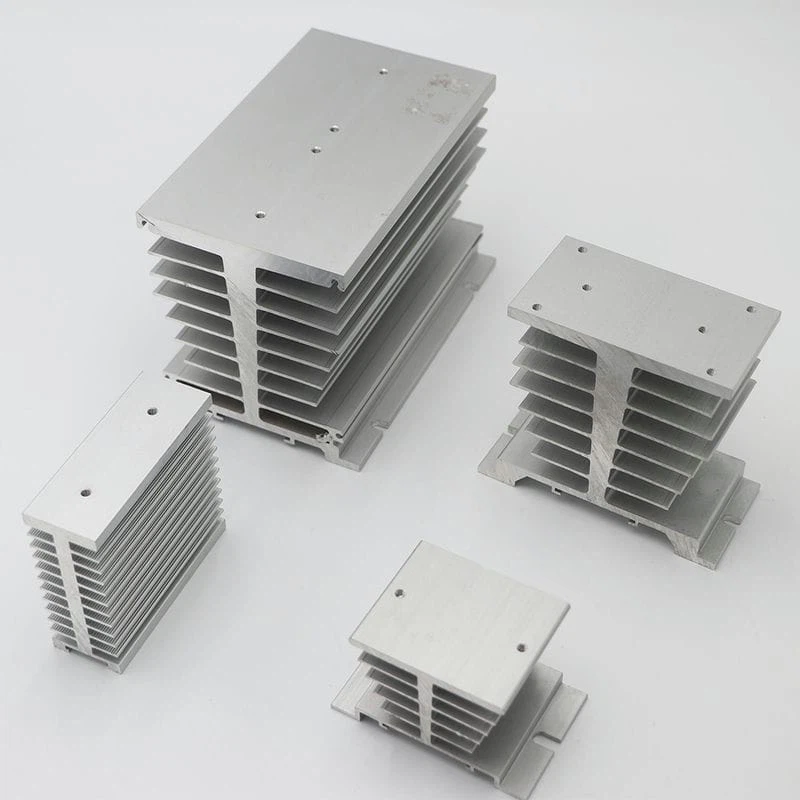

For example, some satellite manufacturers use Aluminium Heat Sink Channel to build heat dissipation modules. These channels can be integrated with other components easily, and their fin - like structures can effectively increase the heat transfer area.
Design and Manufacturing Considerations
Designing aluminum profile heat sinks for aerospace applications requires a high level of precision and innovation. The first step is to understand the heat load and operating conditions of the aerospace system. Based on this information, engineers can determine the appropriate size, shape, and material of the heat sink.
The shape of the heat sink is crucial for its performance. Finned heat sinks are very common in aerospace applications because they can increase the surface area available for heat transfer. The fin density, height, and thickness need to be optimized to achieve the best heat dissipation efficiency. In addition, the overall structure of the heat sink should be designed to fit into the limited space of the aerospace system.
Manufacturing aluminum profile heat sinks for aerospace also requires strict quality control. The aerospace industry has very high standards for product quality and reliability. High - precision manufacturing processes, such as extrusion, machining, and surface treatment, are used to ensure the dimensional accuracy and surface finish of the heat sinks. Non - destructive testing methods, such as ultrasonic testing and X - ray inspection, are often employed to detect any internal defects in the heat sinks.
Economic Considerations
From an economic perspective, using aluminum profile heat sinks in aerospace applications has both advantages and disadvantages. On one hand, aluminum is a relatively inexpensive and abundant material compared to some high - performance alloys used in aerospace. This can reduce the raw material cost of manufacturing heat sinks. In addition, the manufacturing processes for aluminum profile heat sinks are relatively mature and cost - effective, which can also contribute to overall cost savings.
On the other hand, the aerospace industry requires strict quality control and certification for all components. This means that additional costs are incurred in terms of quality assurance, testing, and documentation. Moreover, the customization requirements for aerospace heat sinks are often high, which may increase the design and development costs.
However, in the long run, the benefits of using aluminum profile heat sinks, such as weight savings, fuel efficiency, and reliable heat dissipation, can outweigh the upfront costs. As the aerospace industry continues to grow and develop, the demand for cost - effective and high - performance heat sinks is expected to increase.
Conclusion
In conclusion, aluminum profile heat sinks have great potential for use in aerospace applications. Their excellent thermal conductivity, low density, and good corrosion resistance make them suitable for many aerospace systems. Although there are some challenges, such as extreme temperature conditions and strict quality requirements, these can be overcome through careful design, precision manufacturing, and strict quality control.
As a Aluminum Profile Heat Sink supplier, we are committed to providing high - quality heat sinks for the aerospace industry. Our experienced engineers and advanced manufacturing facilities can ensure that our products meet the strict specifications and requirements of aerospace applications. If you are involved in the aerospace industry and looking for reliable heat sink solutions, we invite you to contact us for further discussion and potential procurement opportunities.
References
- S. Kakac, A. E. Bergles, and F. Mayinger, Heat Exchangers: Selection, Rating, and Thermal Design, CRC Press, 2003.
- H. R. Tippets, "Aerospace Materials and Processes Handbook", McGraw - Hill, 1984.
- B. R. Munson, D. F. Young, T. H. Okiishi, and W. W. Huebsch, Fundamentals of Fluid Mechanics, John Wiley & Sons, 2012.